CVI (Cortical Visual Impairment) in Older Children: What Should Parents Notice?
Some common signs include difficulty locating items in the surrounding environment, such as a game on a cluttered store shelf or a restroom sign. In some cases, a person may trip while walking, such as by missing a step or a curb, which could be a visible sign. In other instances, individuals are likely to have difficulty in distinguishing between certain letters that are close in appearance, like b and d, or i and l.
While children with CVI can see, they cannot make sense of what they see because the problem lies in how their brains process visual information. The encouraging thing is that the children can improve with appropriate treatment and therapy for cerebral visual impairment. Dr. Aabha Pradhan, having specialized training and lots of experience in CVI for children, assists doctors by:
- Comprehensive evaluation of the child’s vision function is a necessity.
- Ensure timely, appropriate vision therapies are provided.
- Understanding the Causes of CVI: CVI is caused by brain damage.
- Common signs: Difficulty in recognizing objects visually, difficulty in perceiving depth, and difficulty in attention.
- Severity can vary from child to child, and assessment must always be tailored to each individual.
- Early identification and appropriate strategies or visual supports can help a child develop better.
How Does CVI Impact Your Child’s Vision?
Notice the conditions that are mentioned below that might cause problems before opting for therapy for cerebral visual impairment:
1. Gaze Control
2. Visual Attention
3. Noticing Movement
4. Visual Analysis and Recognition
5. Visual Memory
6. Visually Directing Your Own Movements
7. Noticing What’s in front of you
8. Visual Field Limitations
9. Variable Vision
What are the Signs of Cerebral Visual Impairment (CVI)?
It is natural for your child to struggle to express what they are dealing with and the visual problem they are facing. That is why here are some key signs to watch for in your child before opting for professional therapy for cerebral visual impairment (CVI).
1. Visual Latency
2. Color Preference
3. Attraction to Movement
4. Visual Field Preference
5. Struggling to Identify Objects in crowded or cluttered environments
6. Light Gazing/Photophobia
7. Limited Eye Contact
8. Not able to blink when an object approaches their eyes (Blink Reflex)
9. Difficulty with Novelty
10. Visual Fatigue
11. Inconsistent Vision
Imperative Causes of Cerebral Visual Impairment (CVI)
Cerebral Visual Impairment results from brain damage impacting visual processing, rather than the eyes themselves. Furthermore, here are some severe causes of CVI that lead to professional therapy for cerebral visual impairment (CVI).
1. Cerebrovascular Accidents (Stroke)
2. Neonatal Seizures/Infantile Spasms
3. Hydrocephalus
4. Congenital Brain Malformations
5. Central Nervous System Infections
6. Traumatic Brain Injury (TBI)
7. Neonatal Hypoglycemia
8. Periventricular Leukomalacia (PVL
9. Hypoxic-Ischemic Encephalopathy (HIE)
What are the Significant Benefits of Cerebral Visual Impairment (CVI) Therapy for Kids?
Therapy for cerebral visual impairment (CVI) for children can be a game-changer for those experiencing visual confusion or visual overload. Activities can become enjoyable for kids with proper guidance. Furthermore, check the significant benefits of professional therapy that enhance your child's vision:
1. Better Visual Attention & Recognition
The primary advantage of CVI therapy is that children gradually learn to attend to stimuli through high-contrast objects, backgrounds, and activities, thereby helping them understand "what to look at." Moreover, it helps them recognize faces, toys, books, and classroom materials.
2. Improved Daily Living Skills & Independence
As vision processing capacity increases, confidence in activities such as dressing, eating, walking, and playing increases. Regarding the physical space, CVI therapy includes strategies to make the child’s physical environment visually friendly. This includes strategies such as decluttering, proper lighting, and step-by-step visual instructions.
3. Reduced Anxiety & Sensory
Overwhelmed Children with CVI may also become stressed because of too many people in one place, bright lights, or too much visual stimulation. By receiving therapy, the child and their parents can increase their visual comfort. Thus, it ensures that there are no meltdowns.
Why Should You Choose Therapy for Cerebral Visual Impairment (CVI) at Nupal CDC?
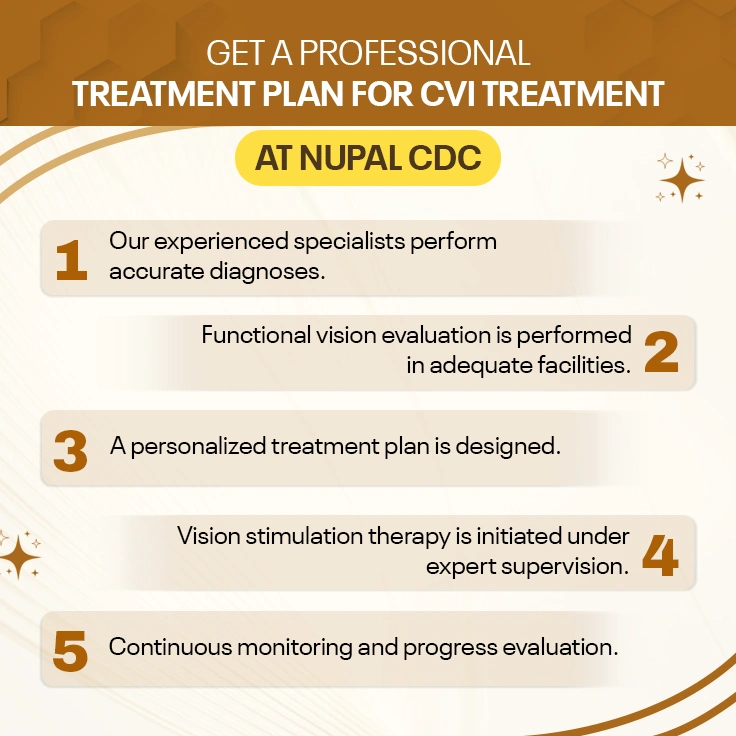
Selecting therapy for cerebral visual impairment (CVI) at Nupal CDC is a smart decision because it not only improves the child’s vision but also supports their development. A child suffering from a visual impairment, or cerebral visual impairment, cannot fully process the visual information they are receiving. Meanwhile, parents are also assisted every step of the way to ensure steady progress at home. The focus of Nupal CDC is on improving the functional vision and making a real difference in daily life activities.
Nonetheless, here are some key reasons to choose Nupal CDC:
- Assessment and therapy plans for the specific needs of CVI
- Multi-disciplinary team support (vision, development focus)
- Targeted work on the child's attention, tracking, and vision recognition
- Play-based, engaging sessions for effective learning
- Parent training with home program guidance
- Progress monitoring with clear goals and updates
- Support for school readiness and daily independence
CALL TODAY TO HAVE INITIAL OCCUPATIONAL THERAPY CONSULTATION (+91) 9910388103
Email: info@nupalcdc.com
Visit us: B-180 First Floor, Gujranwala Town Part 1, Delhi 110009, India