
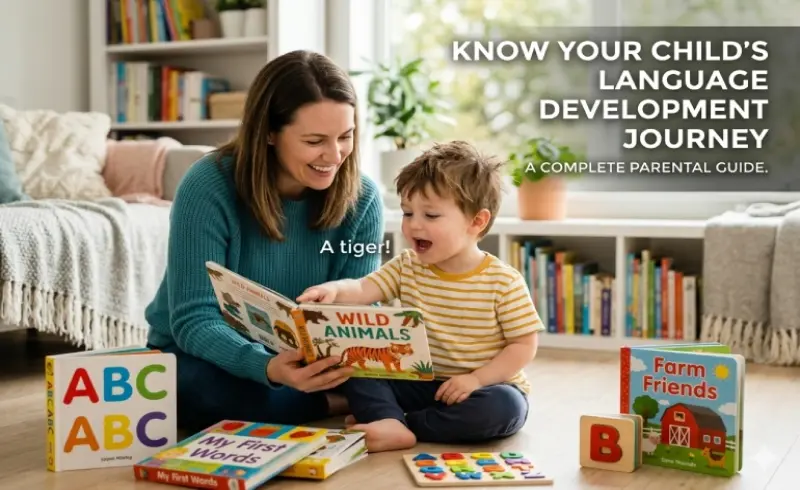
Know Your Child’s Language Development Journey - A Complete Parental Guide
Speech Therapy for Children
16 Mar, 2026
Watching your child's language development is another source of happiness for any parent. From waiting for your toddler to utter their first word to feeling delighted when they convey their thoughts in broken sentences, tracking language development for early childhood is one of the most joyful journeys you will take as a parent. From those first giggles to the day your kid confidently shares a short summary of their entire day, each milestone is an open door into how they see the world.
Language development is imperative to a child’s journey because it encourages them to communicate, express, and understand what they are feeling. Knowing how communicative growth can help parents create an environment that fosters their kids’ language use. Likewise, language milestones for 3 year old are essential foundations for a child’s lifelong learning, self-expression, and social connection. Nevertheless, in this comprehensive guide,
What is Language Development in Early Childhood?
Language development for early childhood is a natural, immediate process from birth to age 5-8 years, in which kids learn to receive (understand) and use expressive language, progressing from babbling and cooing to forming complex, grammatically accurate sentences. It is crucial that development be driven by social interaction, a language-rich environment, and play-based learning. Likewise, exposure to conversation and language development for early childhood is core to developing crucial skills for child to convey their thoughts and express their feelings without facing any difficulties.
Crucial Stages of Language Development In Early Childhood
When it comes to language development, there are several stages present as kids advance from simple words to mastery of difficult vocabulary and grammar. Furthermore, here is a comprehensive overview of what happens in each phase, from which you can learn about language disorders in children:
1. Pre-linguistic/Foundation Stage (Birth to 3 Months)
Newborns express through eye contact, crying, body movements, and facial expressions in the first few months of life. Additionally, they begin to make babbling and cooing sounds in response to human interaction.
Key Speech and Language Milestones to know:
- Crying to Signal Needs
- Cooing and vocalizing happiness
- Reacts to loud sounds by startling or waking up
- Start smiling in response to voices or smiles from others
- Start to make sounds to engage in back-and-forth interaction
As professionals at the best clinic for speech development, we motivate pre-speech development through singing, reading books, and talking to babies from day one. Nevertheless, these interactions help build early bonding and communication skills.
2. Babbling Stage (3 to 6 Months)
In the babbling stage, kids become more vocal. They play and discover new sounds by hanging in accordance with vowel combinations, such as “da-da” or “ma-ma”. It is their first step in understanding phonological awareness, which is how we know and produce sounds in speech. Nevertheless, it allows babies to practice making speech sounds in preparation for language development for early childhood.
Key Speech and Language Milestones to know:
- Starts to mimic some sounds
- Use different emotions and pitches in babbling
- Responds after hearing their own name
- Uses gestures or sounds to interact with others, such as vocalizing and giggling
- Babbles with sounds like mamabababa
3. First Words (6 to 12 Months)
Around a child’s first birthday, they usually speak their first words, such as baba, mama, or dada. Furthermore, if your baby is not developing these words, they might be exhibiting signs of language disorders in children. Early words often relate to family members, everyday routines, and known objects. Apprehending precedes words, so toddlers might answer to words before they can say them.
Key Speech and Language Milestones to know:
- Starts to understand and follow simple instructions and commands
- Gestures or points to objects when named
- Babies learn to sit without support and use their hands for balance or playing
- Copy sounds, and start using gestures
- Says first words like dada, mom, and baba
4. Language Explosion (12 to 24 Months)
After expressing those first endearing words, a toddler’s vocabulary rapidly takes off. They mix-match different words to speak in phrases, such as "bye bye mama," "mama more water," or "I want food." Moreover, by 24 months, toddlers start speaking in 7-8-word sentences with the right vocabulary. Likewise, understanding developed dramatically during language development for early childhood.
Key Speech and Language Milestones to know:
- Learn new phrases quickly
- Mix-match words into short phrases
- Vocabulary bounces to around 40-50 words
- Ask endless questions using words like “what,” “where,” and “why.”
- Confronts in short back-and-forth conversations
5. Complex Speech (24 to 36 Months)
A toddler’s language development is in bounds and hops between the ages of two and three. Therefore, sentences become more complicated and longer. Vocabulary develops rapidly to around 300 words. Communication starts to include explanations of past, present, and future events.
Key Speech and Language Milestones to know:
- Asks endless and creative questions
- Uses pronouns, such as “you,” “me,” and “mine.”
- Vocabulary grows to 350+ words
- Blends 3-4 words in sentences
- Enjoys silly language games and rhyming
6. Sentences and Grammar (3 to 5 Years)
Language milestones for 3 year old and 5-year-old children, it include gaining mastery of grammar rules and sentence alignment. Children’s growth transitions from short to longer sentences, more-explained sentences, and the use of the right grammar components, such as prepositions and conjunctions. Difficult language capabilities, like joking, understanding metaphors, and telling imaginary stories, occur.
Key Speech and Language Milestones to know:
- Makes up short stories, expresses ideas and opinions
- Asks many questions about "how" and "why."
- Engages in extended conversations
- Learns around 5 new words a day
- Uses speech that is easy to understand
- Uses 5 to 6-word sentences
How to Promote Language Development in Your Children?
As parents, here are some of the many ways you can support the development of your child’s language at different stages:
1. Engage in warm face-to-face contact with the child from the very beginning. This lays the foundation for early communication.
2. Reading, singing, and talking to the baby or infant, babies learn through the care and attention of the caregiver.
3. Responding to the coos, babbles, or any sounds the baby makes. Engage the baby in back-and-forth sounds.
4. Using gestures such as pointing, showing, or waving. These are early forms of communication.
5. Naming objects, actions, or ideas while engaging with the child.
6. Reducing screen time for the child, as this reduces the number of critical interactions.
7. Expanding on the child’s words. Repeat the child’s words and add one more word.
8. Asking open-ended questions or listening attentively. This helps the child develop conversation skills.
9. Engaging the child with books, songs, rhymes, or stories. This exposes the child to rich language.
10. Seeking early intervention for any delays from a pediatrician or speech pathologist.
Final Words!
Language development in early childhood is imperative for a child’s emotional, social, and cognitive development. Comprehending all the valuable stages of language development in a child helps every parent to appreciate every new sentence, question, and word the child says. The journey from babbling to properly expressing their thoughts is unrealistic.
At Nupal CDC, as the best clinic for speech development, we are passionate about early language growth and take a developmental approach to caring for toddlers. Our supportive and friendly staff understands the significance of speech and language milestones. Also, we create a nurturing environment by promoting communication skills through songs, play, storytelling, and friendly interaction. Book your child's language and speech consultation today!
Frequently Asked Questions
When should parents seek the advice of a specialist for the development of language in children?
Ans: If the child is not able to utter words by the time he or she is 18 months old, parents should seek advice from a specialist, as language development in children can be quite effectively supported in such situations.
How can the development of language be improved at home?
The development of language in children can be improved by engaging in various activities at home. Check them out
- Parents should talk to their children regularly
- They should read children's storybooks
- They must listen to songs and respond to their children's words.
- Parents should also encourage children to talk when they try to utter words and try to enhance the child's vocabulary.
Does excessive screen time impact the development of language in children?
Yes, it affects children's language development because they may not learn the language as quickly as other children do. Children naturally learn language by interacting with other children, so it is better not to allow them to spend too much time in front of screens, as this may affect language development.
How many words should a 2 to 3 years old child be able to speak?
Children can speak around 50 words by the time they reach 2 years of age, and the number of words may significantly increase when they turn 3. Children can speak sentences consisting of 3 to 4 words when they reach 3 years of age. If the child is unable to communicate, it is better to seek advice from a specialist.
Leave a comment