
Language Development for Early Childhood - Strategies for Parents and Educators
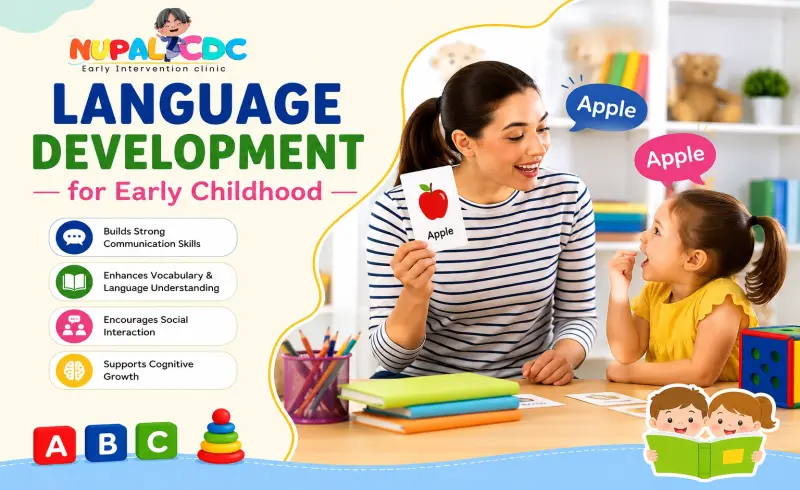
Speech Therapy for Children
01 Jun, 2026
Many children fail to reach their developmental milestones at the appropriate time due to mental, emotional, and physical challenges. Failing to address these challenges at an early stage leads to long-term effects that often persist into adolescence. That is precisely why proper communication and language development for early childhood require professional attention. Early intervention and treatment from qualified professionals significantly improve success rates and ensure steady, age-appropriate development in kids.
Seeking the right professionals to ensure age-appropriate language development for early childhood is your active responsibility as parents, one you must be aware of and fulfill without fail. However, that does not end your side of your work. While your kids are undergoing professional treatment, there are many ways through which you can contribute to their growth.
In this blog, we will discuss some highly effective activities that will help parents and educators support early development in kids.
Get Effective Results in Kids’ Development with Scientifically Proven Activities
Reaching out to a professional for treatment is the best way to address the challenges in language development for early childhood. Meanwhile, there are many activities parents can do at home to achieve better results in less time.
1. Interactive Storytelling
Reciting bedtime stories or acting them out in front of your kids is a fun way to improve their vocabulary and help them form more words and longer sentences. Consequently, you will be able to contribute to your children's language development while fostering their imagination and social interaction, saving them from the fear of speaking.
2. Sound Isolation and Discrimination
Another major task is focusing on recognizing and memorizing the pronunciation of each phoneme in words, so they won’t stumble. Thus, help your kid distinguish between complex and similar sounds, such as “b” vs. “p.” This will strengthen phonological awareness and provide a strong foundation for improving their pronunciation.
3. Social Story Practices
Language development for early childhood can also be promoted by using short, moral stories to teach kids social and communication skills. By engaging in fun activities that bring them enjoyment, children love and enjoy stories the most. With the help of stories, you can teach children about everyday situations and make them understand greetings, sharing, and more. Stories help children with difficulties in social interaction and being vocal, while they are also beneficial for those with autism.
4. Speech Sound Drills
Repetitive practice of specific sounds or words is another expert-recommended way to help children with difficulties in language development. In this practice, you can target the specific words, sounds, or sentences they find difficult to use or say. Language development in early childhood improves by targeting articulation errors and, with practice, improving speech clarity over time. For better results, you can target these practices with visual or tactile cues.
5. Expanding Sentences
Encouraging children to expand the sentences you say, or to make each sentence longer and more complex, is helpful. For example, starting with a simple word “dog” to make it “big brown dog,” further expanding “a big brown dog in the neighborhood.” Similarly, you can have the children practice using the word they find complex so they can understand its meaning and use it more deeply.
This way, language development in early childhood is prompted over time as they learn new words and refine their pronunciation. Their grammar, syntax, and expressive language skills also develop when they practice such exercises regularly, whether with parents or teachers.
6. Positive Reinforcement
Anything appreciated brings more joy and our attention to maintain it. In the same way, children also promptly improve themselves if they are rewarded with praise for correct speech attempts. Furthermore, tokens and fun activities encourage their learning and active participation in the journey to improve their language skills. Positive reinforcement from parents and experts encourages and motivates them to keep practicing, while building confidence and reducing frustration during therapy.
7. Mirror Exercises
To improve speaking words clearly, children can practice in a mirror, meaning they can watch their mouth movements while speaking. It improves awareness of the articulation and sound production they make and use in words and sentences. It’s a highly effective method for correcting mispronunciations and practicing facial movements that helps with better results and faster improvement.
Final Words!
Language development for early childhood is crucial for developing effective skills that enable children to communicate effectively in the world around them. It can be done through storytelling, speech practice, and social interaction, just by engaging children more in suggested activities. Early intervention and regular training play an important role in dealing with any problems regarding speech or language development. For a detailed understanding of the structured steps a therapist takes to address your child's language difficulties, you can contact Nupal CDC.
Therapy services with us include speech therapy, occupational therapy, and other developmental therapy sessions conducted by specialized professionals. We provide our services both offline and through video call consultation services, depending on parents' availability. By enrolling your children in our clinic, you gain access to an expert who will help with their developmental and communication issues. In addition, we also cater to their walking issues, sitting issues, potty training, and more.
FAQs
Q1. Why does the right treatment for language development matter at the right time?
Ans: Early intervention for language development matters because, if not addressed in time, children grow up with low self-esteem and fumble with speaking. Their lack of language development makes them afraid of social situations, leading them to lose friends, opportunities, and more.
Q2. What are some of the benefits of visiting an early intervention clinic?
Ans: The major benefits come in the improvement of your child's behavior, growth, and creativity, as the experts at the clinic help them. Overcome the shortcomings that lead to them being vocal, social, and verbally expressive of emotions and thoughts. A consultation at a good clinic provides a careful evaluation of all these points, which in turn leads to secure therapy sessions.
Q3. Can I get a free consultation at Nupal CDC Clinic?
Ans: Of course. We offer free consultations for children on their first visit, so parents can observe our capabilities and understand the process. We are one of the best intervention clinics in Delhi with a commitment to supporting parents with their child services.
Q4. Do you also provide virtual consultation if a physical visit is not possible?
Ans: Yes, Definitely. We understand the busy schedules and parents' concerns about consulting at the right time. So, our experts are also available for an online consultation for your children if a physical visit to the clinic is not possible. You can book the consultation through the information present on our website, and for further details, connect with us.
Q5. What are some of the services that Nupal CDC offers?
Ans: We offer a range of services to help foster your children's growth through proper techniques and measures. It includes Occupational Therapy, Low Vision, Clinical Psychology, Speech Therapy, Applied Behavior Analysis, Special Education, and Cerebral Visual Impairment. If you have any questions or would like to consult our professionals regarding your children, contact us immediately.
Leave a comment