
The Significance of Integrated Learning in Language Development for Early Childhood
Speech Therapy for Children
08 Jul, 2026
Have you ever thought about the depth of integrated learning in language development for early childhood? Well, before we delve into the topic, let’s first understand what integrated learning is.
As we all know, integrated learning is significant in early childhood education because it reflects how kids naturally experience the world they are living in. By combining subjects such as science, art, language, and math into cooperative, hands-on themes, it promotes the “whole child,” promoting deeper cognitive, social, and emotional development simultaneously. Furthermore, integrated development in early childhood is a beneficial approach that combines multiple intelligences, enabling children to acquire diverse knowledge in the early years of schooling.
Once the preschool years are over, students have acquired a wide range of knowledge that is directly linked to their intellectual development. Nevertheless, it is significant that language development for early childhood supports issues related to values, self-esteem, and emotions. Additionally, in this comprehensive blog, we will discuss the significance of integrated learning for children.
What is Integrated Learning in Language Development for Early Childhood?
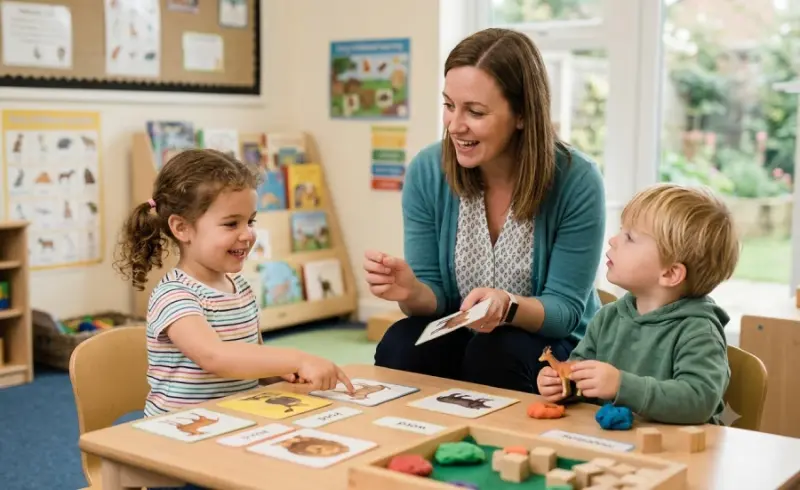
Integrated learning in early childhood language development is a holistic educational approach in which language skills, such as speaking, reading, writing, and listening, are taught naturally through meaningful, play-based experiences rather than through isolated drills. It entangles literacy with other developmental fields such as maths, science, and social-emotional learning. This significant method mirrors how young children naturally explore the world. Rather than parsing life into different subjects, integrated learning embeds communication into hands-on tasks, making language acquisition more natural and organic.
Why Early Intervention Matters?
Here are some fundamental reasons why early intervention is vital for kids’ language development for early childhood:
1. Boosts Receptive & Expressive Language
Kids learn to process what is being articulated (expressive language) and said (receptive language), which is vital for following directions and understanding lessons.
2. It Encourages Social Integration
Speech therapy in Delhi builds the communication skills needed to play and cooperate with peers, promoting emotional regulation and reducing classroom frustration.
3. It Improves Critical Thinking
Language forms the basis of cognitive processes such as reasoning and problem-solving. Likewise, early intervention revs these skills, leading to better reading and writing capabilities.
Benefits of Integrated Learning in Language Development for Early Childhood
Early intervention in the form of speech therapy is known to produce positive outcomes for a child's learning journey. This is the period in which communication, language, and comprehension skills of a child begin to emerge. With early help, children learn to express their thoughts, comprehend instructions and directions, socialize, and participate fully in activities.
Apart from helping children overcome difficulties with communication, speech therapy in Delhi contributes to the emotional, psychological, social, and cognitive development of children. Therefore, it is among the main reasons why parents explore speech therapy assistance. The importance of language development for early childhoodis undeniable since this skill will benefit a child not only during learning but also throughout life. Here are several advantages of integrated language learning for kids.
1. Promotes Cognitive Flexibility
Children naturally learn in an integrated way because it allows them to associate language with various actions such as painting, counting, dancing, or playing. As a result, they don't memorize separate words but see the connection between language and activities. This approach helps children become more flexible and learn to perceive situations from different perspectives. As a consequence, they find it easier to grasp new information and apply language in different situations.
2. Increases Vocabulary Retention
Everyone knows that information is easier to memorize if we experience it first-hand. This rule also applies to language learning when words taught via different activities tend to stay longer in a child's memory than those memorized with rote practice. For example, a child who actively participates in cooking will remember the verbs associated with these actions better than just memorizing a list of words related to cooking without actually preparing anything.
3. Encourages Comprehension
Comprehension in language development for early childhood is much more than remembering the meaning of individual words. Understanding what people say involves interpreting language and analyzing information, making associations, and forming a coherent thought. Through integration, children develop these essential skills by learning topics through multiple activities. For example, exploring such themes as animals, planets, nature, or other subjects through books, drawings, playing, and storytelling can contribute significantly to comprehension skills.
4. Develops Executive Functioning Skills
Many activities require additional skills that complement communication. While listening and repeating instructions, children also have to concentrate on certain aspects of the lesson and follow specific sequences of steps. From simple actions like counting objects to complex activities such as completing puzzles, children improve their executive functioning and thinking skills by practicing different aspects of learning language and interacting with others.
5. Fosters Social Communication Skills
Interacting with other children in a classroom environment is a good opportunity for children to practice their communication skills and learn the rules of interaction. Participating in teamwork and discussions, taking turns to speak and listening, sharing opinions, and negotiating- all of these actions enhance children’s language development for early childhood and boost self-confidence.
6. Ensures High Engagement
Children are naturally curious, and the most effective way to engage them in learning is to relate it to interesting topics that attract their attention. Integration provides a variety of opportunities for children to be active participants in the educational process. Since children participate in different discussions and activities, they are encouraged to be more involved in the learning process and express their opinions and suggestions. This level of engagement provides numerous opportunities to improve language skills.
7. Enables Practical Application of Language
Real-life application of knowledge is impossible without using various skills simultaneously. Communicating with friends, completing tasks, discussing topics, and solving problems involves both language and other skills. Integration of activities shows children how to apply language in practice. Combined with speech therapy in Delhi, such learning allows kids to master language and develop important skills needed to succeed.
It’s Time to Wrap Things Up!
Learning and early speech interventions go hand-in-hand in fostering the development of a child. With an integrated learning program that combines the teaching of language and providing real-life situations, children learn the skills necessary to effectively express themselves, learn and develop into confident individuals. Through activities such as exploration, critical thinking, and socialization, children will develop their language skills as well as develop other valuable skills that they need in life.
However, if you are searching for professional assistance for your child’s language development for early childhood, look no further than Nupal CDC. We ensure that your child confidently develops into an independent communicator who speaks up in the world. We know that all children deserve a healthy beginning, and all parents deserve some relief from stress and more time to watch their children grow. So, what is stopping you? Contact us or schedule an appointment, and we will take care of everything else.
Frequently Asked Questions
Q1. Can integrated learning and speech therapy be used together?
Ans: Certainly. Integrated learning ensures many opportunities for communication practices, whereas speech therapy provides help in resolving language-related issues. Together, these strategies will provide the child with all the necessary knowledge for proper growth and development.
Q2. What can integrated learning contribute to language development of children?
Ans: Integrated learning helps children develop language skills, such as speaking, reading, writing, and listening, through the process of participating in different everyday activities, games, and classes.
Q3. What are some of the reasons for choosing speech therapy for children?
Ans: Check out the fundamental reasons:
- The child's vocabulary is significantly limited compared to other kids.
- The child cannot follow even the simplest instructions.
- The child speaks unclearly, so others have difficulty understanding.
- The child has difficulty conveying his or her requests.
Q4. Why is early intervention crucial for the child's language development?
Ans: It is always better to resolve any issues related to communication as soon as possible before they start to influence a child's learning and social development adversely.
Q5. How does speech therapy assist in developing communication skills?
Ans: Speech therapy allows children to speak clearly, increase their vocabulary, learn to listen, use proper grammatical constructions, etc.
Leave a comment