
Notice Early Signs of Cerebral Visual Impairment in Children That Every Parent Should Know
Parenting & Family Support
09 Feb, 2026
Cerebral visual impairment in kids is medically defined as amblyopia or a functional disorder. As per the medical information, every year cerebral visual impairment affects about 5 to 7% children significantly. When it affects children before their eyes are fully developed and before their eye structures are healthy, it is a crucial time for parents to be especially vigilant about their children's health. The CVI results from a disruption in the growth of the visual pathway between the eye and the brain in early childhood.
Furthermore, childhood visual impairment can significantly affect a child’s development, learning, and overall quality of life. Thus, considering therapy for cerebral visual impairment (CVI)can help you get the right treatment for your kid’s life. Likewise, in this comprehensive guide, we will discuss key information for parents to recognize early signs of vision problems, understand their causes, and more. Diagnosis at the right time is key to helping innocent kids reach their full potential. Having accurate information helps parents play a vital role in their child’s vision health and overall well-being.
What is Cortical Visual Impairment (CVI)?
Cerebral Visual Impairment is also known as Cortical Visual Impairment (CVI). It is a neurological condition in which the eyes are healthy, but the brain cannot properly process the visual signals they send. It is a leading cause of pediatric vision loss in developed countries. CVI is normally caused by early brain injury, such as trauma, prematurity, or oxygen deprivation at birth (HIE). Furthermore, such a situation needs immediate therapy for cerebral visual impairment (CVI) to ensure that children get the treatment at the right time. Characteristic behaviors include problems with visual complexity, delayed visual response, and a preference for moving or highly saturated objects (often yellow or red). While permanent, vision can often be enhanced through early intervention and environmental adaptations.
Check the Top 7 Early Signs of Cerebral Visual Impairment in Kids
In some instances, a child may have seemingly normal vision yet still be unable to see clearly. In such a case, the child is not seeing clearly, not because of the eyes but because of the brain. Cerebral Visual Impairment is increasingly common among children. The seven signs of CVI in children are as follows, before opting for therapy for cerebral visual impairment (CVI):
1. Confusion while observing things, especially when the place is crowded
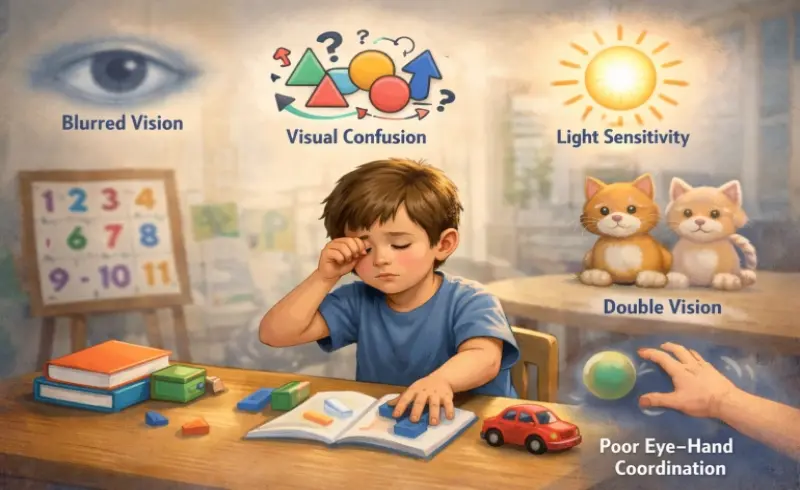
If you know your child has difficulty locating items, whether in a shopping center, class, or among toys, this is likely a significant sign. In CVI, the brain has difficulty processing visual information, and the child can easily get distracted by background noise. For Example, children with CVI cannot remove the favorite car from the toy box, but they can recognize it when it is placed alone on the table.
2. Unusual reaction to light (too much or too little)
Some children may be annoyed by the bright light, close their eyes, or turn their face away. Furthermore, some children repeatedly look at the light, as if they are attracted to it. This "light gazing" or "light sensitivity" presents an initial sign of CVI. While a parent might think this is a habit, the brain is actually responding to “an easy visual target.”
3. Difficulty in Face Recognition and Eye Contact
Some children may not process visual information from faces well. Therefore, they may avoid eye contact or take time to identify the face. In some cases, the child can identify the face but fails to identify the source of the voice. The source of the vision disturbance in such cases may be autism or the child being shy, but it could also be CVI. In such cases, the problem can be improved by receiving therapy for cerebral visual impairment (CVI).
4. Inconsistent eye use (sometimes noticing, sometimes not)
This sign puzzles the parents the most. The child may clearly see the object or not notice it at all. As a result, they believe they are simply "irresponsible" and "not paying attention." However, their level of vision in CVI can vary from day to day, depending on various factors. At this stage, early intervention and therapy for cerebral visual impairment are of utmost importance.
5. Noticing movement more easily, missing static objects
Children with CVI can often follow moving objects but have difficulty tracking stationary objects. Have you noticed that your child may be interested in the fan turning in the ceiling or the car moving down the street, but will not look at a stationary book or the stationary pieces in a puzzle? It is one of the early signs of CVI that, as parents, you have to notice and opt for therapy for cerebral visual impairment (CVI).
6. Depth Perception and Hesitation Around Stairs
Children who are nervous about climbing stairs may not necessarily be afraid of those situations. Impaired depth perception can cause a child with CVI to be unaware of where the stairs end. For Example: Taking each step carefully as one goes up and down stairs, or avoiding climbing up a slide at a playground. Nevertheless, this behavior is often described as "clumsy," but it's actually an issue with visual processing and needs professional therapy for cerebral visual impairment (CVI).
7. Delay in recognizing even familiar objects
If a child is taking a while to recognize their bottle, spoon, shoes, or favorite toy, or appears confused, this is not normal forgetting. Children with CVI exhibit delayed object recognition, particularly when the object changes in angle, color, or position. For Example: Recognizes a cup on a dining table, but not a cup on a kitchen counter.
It’s Time to Wrap Things Up!
Cerebral Visual Impairment in kids can be challenging and overwhelming at the same time. However, with the right information, early diagnosis, and appropriate therapy, these difficulties can be turned into strengths that motivate children. Moreover, as a parent, knowing the meaning of “visually impaired,” the different types of visual impairment, its causes, and which therapies help is your first step in advocating for your children.
At Nupal CDC, Delhi, we have an end-to-end team of skilled, professional experts who help your children receive the best therapy for cerebral visual impairment (CVI). We also provide expert guidance, emotional support, and therapy every step of the way.
Frequently Asked Questions
Q1: What do Children with Cerebral Visual Impairment (CVI) see?
Ans: Children facing CVI explain their vision as follows:
1. They can understand things visually, but the brain can not process them properly.
2. Kids with CVI can notice light or some specific bright colors, but it is challenging to identify where one object ends and another begins.
Q2: Is Cerebral Visual Impairment permanent?
Ans: CVI is considered the most common cause of permanent visual impairment in kids. Furthermore, it can sometimes be accompanied by cerebral palsy and developmental delays. Nevertheless, the good news is that, in many cases, vision can be partially improved.
Q3: What are the Early Signs of Visual Impairment?
Ans: When vision loss begins to develop, some symptoms may appear, such as:
1. Blurry vision
2. Eye pain
3. Floaters and flashes (seeing dots or light flashes in front of the eyes)
4. Light sensitivity (photophobia)
5. Sudden loss of vision or sudden appearance of black spots
Q4: At what age does visual impairment usually occur?
Ans: Vision loss can occur at any age, but vision impairment and blindness are more common among adults aged 50+.
Leave a comment