
Early Signs That Your Child Might Have Autism Spectrum Disorder
Autism Spectrum Disorder (ASD)
17 Apr, 2026
Early childhood is an extremely significant stage in the life of any individual. It is vital for parents to be able to notice all the behavioral traits of their children, how well they communicate, and interact with others. In some cases, seemingly insignificant signs can indicate serious problems with the development of a child, and the correct identification of these signs can have a positive effect on future development, including autism spectrum disorder therapy.
Moreover, in this comprehensive blog, we will discuss some early signs that will help you determine whether your child needs additional assistance.
What is Autism Spectrum Disorder in Children?
Autism Spectrum Disorder (ASD) is a developmental disability caused by brain differences, generally appearing before age three. It affects how children socialize, interact with others, and perceive the world. The word “spectrum” refers to a wide range of signs and severities. Therefore, some kids may have advanced conversational skills, while others with ASD are nonverbal. In autism, common characteristics include limited eye contact, intense focus on specific topics, challenges with social communication, strict adherence to everyday routines, and repetitive behaviors (for example, hand-flapping). Moreover, it is a lifelong condition, but early intervention services can significantly enhance a child’s development and skills.
Symptoms of Autism Spectrum Disorder to Identify in Your Kids
Here are some vital signs of ASD that, as parents, you must identify at the right time in your toddlers.
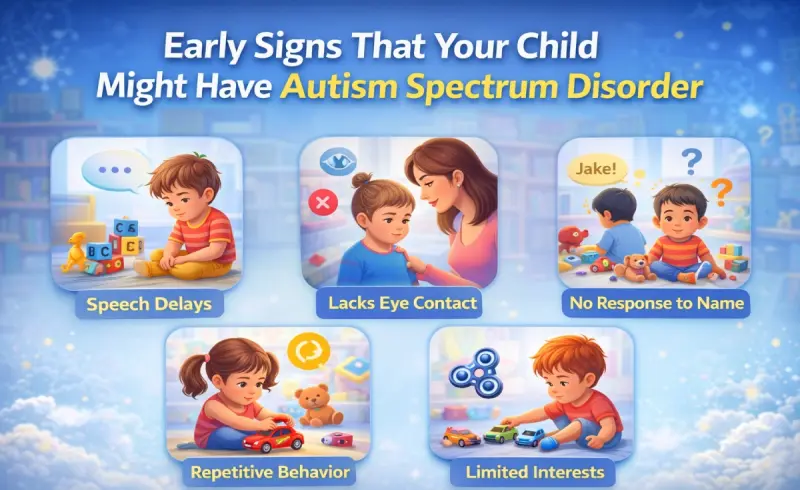
1. Lack of Response to Their Name
A key early sign is when a child does not respond to their name being called. By 12 months, most toddlers will look, respond with a smile, react, express, or look, but a child with autism spectrum disorder may seem to be in their own cocoon, appearing not to hear you at times, despite having no hearing impairments. They might consistently avoid making eye contact or have very inconsistent eye contact when interacting with others.
2. Delayed Speech or Atypical Language Patterns
Language delays are common, such as not babbling by 12 months or using single words by 16 months. When language evolves, it may be unusual, such as repeating phrases or words word-for-word, a behavior known as echolalia. However, it may look like a tiny toddler repeating a phrase from a cartoon instead of initiating their own conversation. Others might speak in a monotone or robotic, sing-song voice rather than a conversational tone.
3. Poor Nonverbal Communication and Social Interaction
Children with autism spectrum disorder often struggle with nonverbal cues, such as gestures. They might not point out objects to show their interest ( for example, pointing at the water, birds, animals, or other things) or wave “hi” or “bye” by 12 months. Their facial expressions may also be limited. Children might not feel excited, pass smiles, or show everyday expressions of joy, anger, playfulness, or surprise by 9 months, leading to challenges in reading social cues and understanding others’ emotions.
4. Strong Preference for Solitary Play
Whereas most kids like interactive games such as pat-a-cake and peek-a-boo at 12 months, an autistic kid is less likely to be interested in such games. The autistic child is more likely to be self-absorbed and less interested in participating in the company of other kids or even their parents. In instances where they participate in games, the autistic child would lack proper engagement skills in pretend play, such as cooking or playing with a toy car.
5. Restricted Interests and Intense Fixations
One of the common characteristics that a toddler with ASD may have is an intense focus on particular and sometimes peculiar subjects or items. Whereas most kids may prefer to play with toys, a kid with ASD may be engrossed in a single object only, such as rotating a car wheel over and over again, rather than rolling the toy car.
6. Strict Adherence to Routines
Children with autism spectrum disorder often thrive on consistency and find it extremely challenging to adapt to new changes in their own routine or world. Even tiny changes, such as a new caregiver, a slight change in breakfast schedule, or a different route to school, can lead to severe tantrums, behavioral outbursts, or distress.
7. Repetitive Behaviors
Repetitive body movements, often referred to as “self-stimulating behavior,” are used by autistic children to control their emotions or cope with sensory input. Furthermore, these behaviors include hand-flapping, rocking back and forth, spinning in circles, or walking on tiptoes. Furthermore, these movements might appear to happen without a particular reason, but are often a way for the child to manage their emotions, whether it's excitement or distress.
Why Identifying the Early Signs of Autism is Vital for Toddlers?
It is necessary to define the early signs of autism because this is an important step that allows the brain development to be intervened with, and leads to better social skills, cognitive skills, and other abilities, along with increasing independence. Early detection also helps establish a link between concerns and actions, so children can be exposed to therapy and treatment at a young age when brain cells are most eager to learn. Likewise, here are some potential reasons why specifying the early signs of autism is essential for your toddlers:
- Early involvement (before age 3) can “rewire” the brain more effectively, as children’s brains are most flexible during these early years.
- Studies show that early recognition and intervention significantly enhance language, adaptive, and social skills.
- Early diagnosis connects families to crucial resources, therapies (such as ABA), and educational tools, reducing potential stress.
- Specifying symptoms early helps address core challenges in communication and behavior. Also, it prevents the amplification of developmental delays.
Wrapping It Up!
Understanding the vital growth of toddlers at an early age is vital. ASD is one of those disorders that stays with a child forever. That is why the right timing in recognizing the early signs and having treatment for ASD can be of great benefit for the child’s growth and development. Each child is different, making early intervention all the more important in helping them grow up healthy.
At Nupal CDC, we understand that each child should be able to get the right advice and help. It is our mission to provide assistance to your child throughout their developmental journey, from initial assessment to autism spectrum disorder therapy. If there is anything you think might concern your child, do not hesitate to reach out to us at Nupal CDC.
Frequently Asked Questions
1. At what age can ASD be diagnosed in toddlers?
Ans: ASD is usually diagnosed at 18-24 months, sometimes earlier, at 12 months. Early diagnosis is necessary since the sooner one can start interventions, the better the results of developmental work will be.
2. Why is early intervention so vital?
Ans: It is vital to note that early interventions allow kids to:
- Favorably affect brain development.
- Enhance communication skills.
- Develop better social skills.
- Easily handle problem behavior.
- Ensure greater independence in the future.
3. Is Autism Spectrum Disorder a lifelong disorder?
Ans: Yes, autism spectrum disorder is a lifelong condition. However, depending on the degree of ASD severity, children can develop their skills in the right way with timely help, assistance, and training, and function adequately enough to live an ordinary life.
4. What can parents do at home to help their autistic child?
Ans: Here are several effective things parents can do for their children suffering from autism spectrum disorder:
- Stick to a certain schedule.
- Encourage eye contact and interaction.
- Use plain language.
- Interest and interact through particular preferences.
- Use reward as a method of motivation.
5. When should one consult a specialist?
Ans: If your child is going through ASD, it is advisable to opt for a certified professional. It should be especially done if:
- The child does not respond to their name at 12 months of age.
- The child does not say a single word at 16 months of age.
- Social interactions are of limited interest.
- Repetitive actions tend to occur more often.
Leave a comment